When you fire up your engine, the deep rumble of the exhaust is likely the first thing that puts a smile on your face. But down at the headers and the muffler, your motorcycle is fighting a battle against extreme heat, road debris, and corrosive gases. The material chosen for this critical component determines not only how long it lasts but also how your bike performs.
For decades, mild steel was the industry standard. It was cheap and easy to work with, but it had a major flaw: it rusted rapidly. As riders demanded better longevity and performance, manufacturers shifted toward stainless steel. Today, stainless steel motorcycle exhaust pipes are the gold standard for both OEM upgrades and aftermarket performance systems.
However, not all stainless steel is created equal. You might see a shiny pipe and assume it is high quality, but the metallurgical grade tells the real story. Understanding the differences between the grades helps you make an informed decision when upgrading your bike. It ensures you aren't paying premium prices for budget materials that might corrode sooner than you expect.
Why is stainless steel the preferred choice for exhaust systems?
Before dissecting the specific grades, it is helpful to understand why this alloy is the material of choice for the majority of mid-to-high-end motorcycles. The primary enemy of an exhaust system is oxidation. The combination of moisture from the road and the condensation created inside the pipe during combustion creates a perfect environment for rust.
Stainless steel contains chromium, which reacts with oxygen to form a passive layer on the surface. This layer prevents rust from penetrating the metal. Beyond corrosion resistance, stainless steel offers a superior strength-to-weight ratio compared to mild steel. This allows manufacturers to use thinner walls for the tubing, reducing the overall weight of the bike without sacrificing durability.
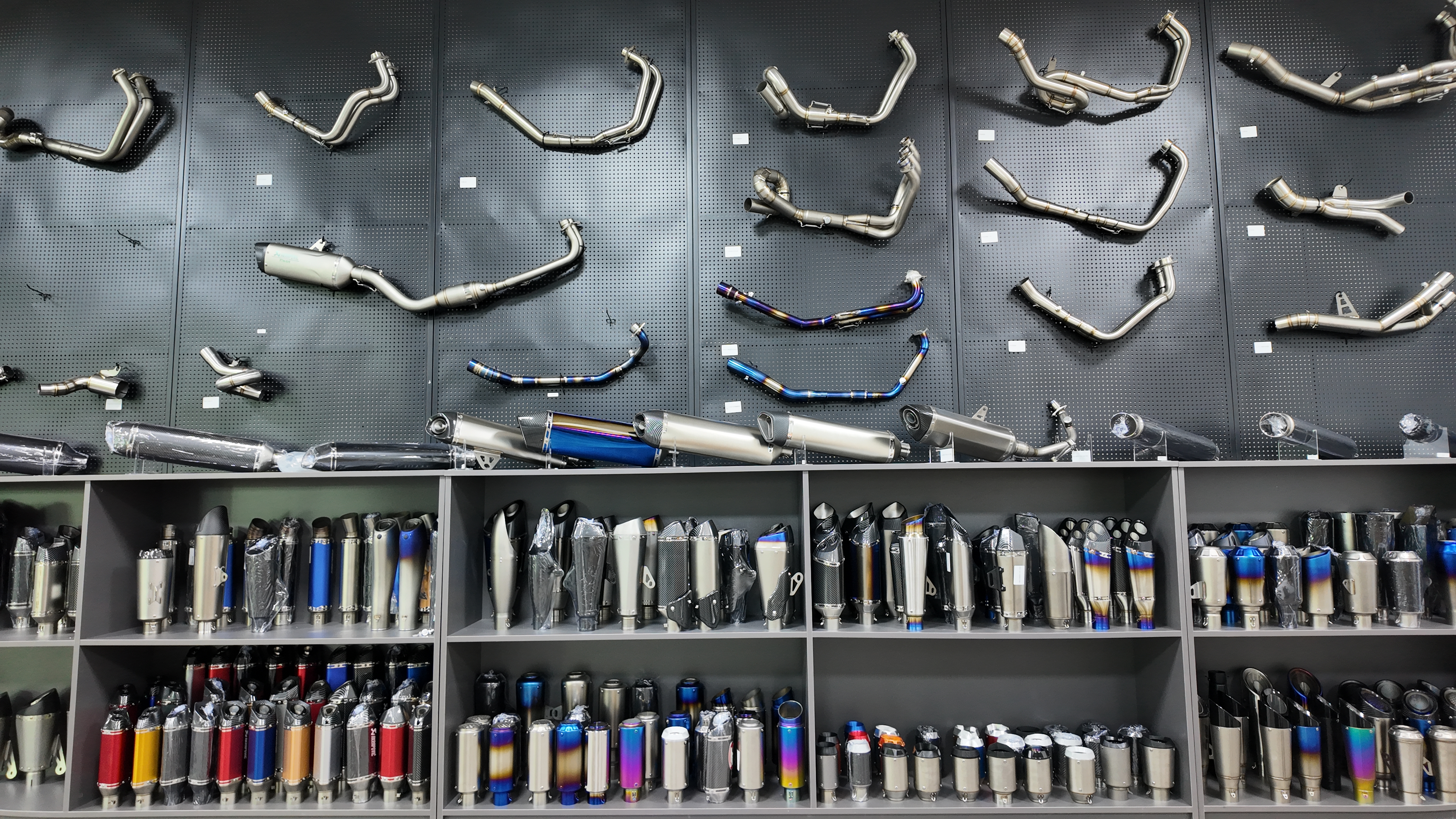
Which specific grades are used in motorcycle exhaust manufacturing?
There are two primary families of stainless steel used in the automotive and motorcycle industries: the 300 series (Austenitic) and the 400 series (Ferritic). The grade number indicates the chemical composition of the alloy, which dictates its heat tolerance and resistance to corrosion.
304 Stainless Steel
This is widely considered the premium standard for aftermarket motorcycle exhaust pipes. It is an austenitic steel, meaning it contains high levels of chromium (usually 18%) and nickel (8-10%). The addition of nickel is crucial because it stabilizes the metal's structure and provides exceptional resistance to corrosion and oxidation, even at extreme temperatures.
304 stainless steel is non-magnetic. If you take a magnet to a high-end exhaust system and it doesn't stick, you are likely dealing with 304 grade. Because it is tougher to manipulate and weld than lower grades, it is typically found in high-performance systems where durability and finish are paramount.
409 Stainless Steel
This is a ferritic steel commonly found in automotive exhaust systems and stock (OEM) motorcycle pipes. It contains chromium but has very little to no nickel. While it is significantly better than mild steel, 409 is prone to developing surface rust over time. It won't rust through structurally like mild steel, but it will lose its aesthetic appeal quickly.
409 is magnetic and cheaper to produce. It is often used for internal baffles or headers that are covered by fairings where visual appeal is less critical.
316 Stainless Steel
Known as "marine grade" stainless, 316 contains molybdenum, which offers superior resistance to salt corrosion. While excellent in theory, it is rarely used in Motorcycle Exhaust Pipe production because the cost is significantly higher than 304, and the benefits are negligible for a vehicle that isn't submerged in seawater.
How do the different grades compare?
To make the selection process clearer, we have broken down the key differences between the most common materials you will encounter when shopping for a new system.
Grade | Magnetic? | Corrosion Resistance | Cost | Common Application |
304 | No | Excellent | High | Aftermarket performance exhausts, premium headers |
409 | Yes | Fair (Surface rusts) | Low | Stock OEM exhausts, automotive mufflers |
316 | No | Superior (Marine) | Very High | Rare custom builds, marine applications |
Titanium | No | Excellent | Premium | Racing, high-end track bikes |
Does the manufacturing process impact the quality of the steel?
The grade of the metal is only half the battle; how that metal is processed defines the system's performance. You can start with high-grade 304 stainless steel, but if the manufacturing technique is poor, the exhaust will fail.
High-quality manufacturers like Jilang utilize mandrel bending techniques. This process involves inserting a rod (mandrel) inside the pipe while it is being bent. This ensures the pipe maintains its diameter throughout the curve, preventing kinks or wrinkles that restrict airflow. Smooth airflow translates directly to throttle response and horsepower.
Furthermore, the welding technique matters. TIG (Tungsten Inert Gas) welding is preferred for stainless steel motorcycle exhaust pipes. It produces precise, clean, and strong welds that can withstand the vibration of a high-revving motorcycle engine without cracking.
How does stainless steel compare to titanium and carbon fiber?
While stainless steel is the most versatile choice, riders looking for the absolute pinnacle of performance often look toward titanium or carbon fiber.
Titanium offers similar corrosion resistance to 304 stainless steel but is roughly 40% lighter. This weight reduction is massive for track days and racing. However, titanium is significantly more expensive and brittle, making it harder to repair.
Carbon fiber is primarily used for the muffler canister (the silencer) rather than the full piping system. It offers the best heat dissipation—meaning it stays cooler to the touch—and is incredibly light. Many riders opt for a hybrid system: stainless steel headers for durability, connected to a carbon fiber or titanium muffler for weight savings and sound.
How can you tell if your exhaust is high quality?
When you are inspecting a potential upgrade for your bike, there are a few tell-tale signs of quality. First, check the magnetism. As mentioned, if a magnet sticks strongly to the header pipes, it is likely a lower-grade 400-series steel.
Next, look at the color. High-quality 304 stainless steel will turn a golden-bronze color after a few heat cycles. This is a normal chemical reaction called "bluing" or "golding" and actually protects the metal. If the pipe turns a dull, rusty brown and feels rough to the touch, it is likely a lower-grade alloy oxidizing.
Finally, inspect the flanges and mounting points. These should be thick and robust. The areas where the exhaust bolts to the engine block endure the most vibration and heat stress.
Ready to upgrade your ride's performance?
Choosing the right exhaust system is one of the best investments you can make for your motorcycle. It reduces weight, improves the exhaust flow for better power, and gives your bike that signature sound.
While there are budget options available in 409 steel, investing in 304 stainless steel ensures your bike looks as good as it runs for years to come. At Jilang, we specialize in crafting high-performance exhaust systems. Whether you are looking for the durability of 304 stainless steel or the featherweight performance of titanium and carbon fiber, our range covers top manufacturers including Ducati, Yamaha, and Kawasaki.
Don't let a rusting stock pipe hold your bike back. Explore our full catalog of high-performance systems and experience the difference quality materials make.
stainless steel motorcycle exhaust pipes
Motorcycle Exhaust Pipe
motorcycle exhaust pipes

 English
 العربية
 Français
 Русский
 Español
 Português
 Deutsch
 italiano
 日本語
日本語 한국어
한국어 Nederlands
 Tiếng Việt
 ไทย
ไทย Polski
 Türkçe
 አማርኛ
አማርኛ ພາສາລາວ
 ភាសាខ្មែរ
 Bahasa Melayu
 ဗမာစာ
ဗမာစာ தமிழ்
தமிழ் Filipino
 Bahasa Indonesia
 magyar
 Română
 Čeština
 Монгол
 қазақ
қазақ Српски
 हिन्दी
 Slovenčina
 Norsk
Norsk Svenska
 українська
 Ελληνικά
 Suomi
Suomi עברית
עברית Latine
 Dansk
Dansk বাংলা
বাংলা Hrvatski
 Afrikaans
 Gaeilge
 Māori
Māori नेपाली
 Oʻzbekcha
 Беларуская мова
 ʻŌlelo Hawaiʻi
 íslenska
 Kinyarwanda


