In the world of motorcycles, few components are as visually prominent, audibly defining, and mechanically crucial as the exhaust pipe. Often the first thing to be customized and the most debated element in terms of performance and legality, the exhaust system is far more than a simple conduit for expelling burnt gases. It is a finely tuned piece of engineering that plays a critical role in the engine's power delivery, efficiency, sound, and even the motorcycle's overall aesthetic. From the simplistic "straight-pipe" of a chopper to the intricate, electronically controlled valve systems on a modern superbike, the evolution of the motorcycle exhaust pipe tells a story of technological progress and passionate rider preference.
The Fundamental Science: How an Exhaust Pipe Works
At its most basic, the exhaust pipe's job is to safely channel hot, toxic gases away from the engine and rider. However, its function is deeply intertwined with engine physics, specifically the phenomenon of exhaust scavenging.
When the exhaust valve opens, a high-pressure pulse of burnt gas erupts into the exhaust port and travels down the pipe. As this pulse moves away, it creates a low-pressure area (a vacuum) behind it. A well-designed exhaust system uses this principle to its advantage. The geometry of the pipe—its header length and diameter, the shape of the collector, and the muffler design—is tuned to create negative pressure waves that help "pull" the next charge of exhaust gases out of the cylinder and, remarkably, even help draw in a fresh air-fuel mixture from the intake. This process cleans out the cylinder more efficiently, allowing for a better new charge and resulting in more power.
This is where the concept of "backpressure" often arises. While a completely unrestricted flow is ideal in theory, some backpressure is a natural byproduct of creating these beneficial scavenging waves. The goal of performance exhaust design is not to eliminate backpressure entirely, but to optimize the pressure waves for a specific engine RPM range, maximizing scavenging for increased horsepower and torque.
A Spectrum of Systems: From Stock to Custom
Motorcycle exhaust systems can be broadly categorized, each with a distinct purpose, performance characteristic, and legal standing.
1. The Stock (OE) Exhaust System:
Designed by the manufacturer as a compromise, the stock system must meet a long list of stringent requirements. It must control noise to pass regulations in multiple countries, reduce harmful emissions via the catalytic converter, be cost-effective to produce, and provide a smooth, manageable power delivery across the entire RPM range. It is often heavier and more restrictive than aftermarket options, as its primary goals are legality, comfort, and environmental compliance.
2. The Slip-On Exhaust:
This is the most popular entry point into exhaust modification. As the name implies, a slip-on system replaces only the muffler (or "can") at the end of the exhaust, "slipping on" to the stock header pipes. The primary benefits are:
●Weight Reduction: Significant savings, as stock mufflers are often heavy steel.
●Sound Enhancement: A deeper, throatier, or more aggressive exhaust note.
●Aesthetic Upgrade: Improved looks with carbon fiber, titanium, or polished stainless steel.
Performance gains from a slip-on alone are usually minimal, as the most restrictive part of the system—the catalytic converter in the header—often remains in place.
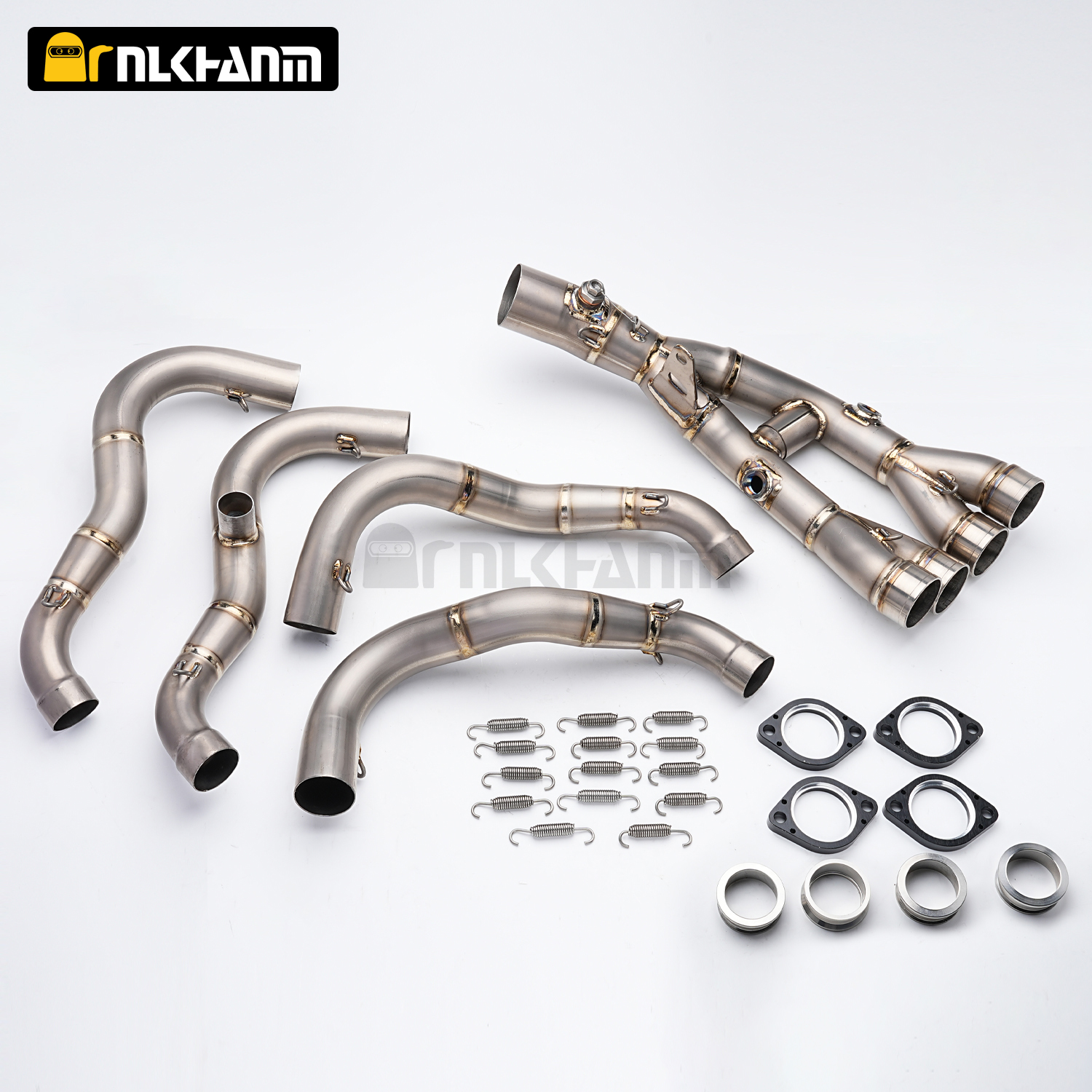
3. The Full Exhaust System:
This is the ultimate performance upgrade. A full system replaces the entire exhaust from the engine head to the tailpipe, including the headers, collector, and muffler(s). Key advantages include:
●Maximum Power and Torque: By removing the catalytic converter and optimizing the header diameter and length for scavenging, a full system can unlock significant horsepower.
●Major Weight Savings: Replacing heavy, complex stock systems with lighter materials can shed 10-20 pounds or more.
●Complete Transformation: Drastically changes the bike's sound, appearance, and power curve.
Installing a full system almost always requires an Engine Control Unit (ECU) remap or a fuel controller to adjust the air-fuel ratio, as the increased airflow can make the engine run dangerously lean.
Materials and Craftsmanship: What Pipes Are Made Of
The choice of material affects the exhaust's weight, durability, heat management, cost, and appearance.
●Mild Steel: The standard for most stock systems due to its low cost. It is durable but heavy and prone to rust from the inside out due to condensation.
●Stainless Steel (e.g., 304 or 409 Grade): The most common material for quality aftermarket exhausts. It offers an excellent balance of corrosion resistance, strength, and cost. It can be polished to a mirror finish or given a brushed look.
●Titanium: The premium choice for high-performance and racing applications. Titanium is incredibly strong and about 40% lighter than steel. It withstands extreme heat and develops a beautiful, unique blue/purple coloration at the headers when heated. Its high cost is the main drawback.
●Carbon Fiber: Used primarily for muffler sleeves due to its lightweight and high-tech appearance. It is not used for headers as it cannot withstand the extreme temperatures.
The Anatomy of Performance and Sound: A Comparative Table
The following table summarizes the key differences between the main types of aftermarket exhaust systems.
Table: Comparison of Motorcycle Exhaust System Types
| Feature | Slip-On Exhaust | Full Exhaust System (Street Legal) | Full Exhaust System (Race Only) |
| Primary Goal | Sound, weight, aesthetics | Max performance, weight savings, sound | Ultimate power for track use |
| Performance Gain | Minimal (0-5%) | Significant (5-15%+) | Maximum (15%+), peaky power band |
| Weight Reduction | Moderate | Significant | Maximum |
| Catalytic Converter | Usually retained | Often replaced with a high-flow cat | Removed entirely |
| ECU Remap Required | Usually not required | Highly Recommended / Required | Mandatory |
| Sound Level | Louder than stock, often with db-killers | Aggressive, sporty tone, may be loud | Very loud, not street-legal |
| Legal Compliance | Often street-legal (with db-killer) | Designed to be street-legal (in some regions) | Not street-legal |
| Cost | Low to Medium | Medium to High | High |
| Installation Complexity | Simple | Moderate to Complex | Complex |
Beyond Performance: The Legal and Social Equation
Modifying an exhaust pipe is not just a mechanical decision; it is a legal and social one.
●Noise Pollution and Regulations: Many countries and local municipalities have strict noise ordinances. A excessively loud "race" pipe on public roads is not only illegal but is a primary source of complaint from the non-riding public, leading to stricter regulations for all motorcyclists. The "Loud Pipes Save Lives" argument is hotly debated, with research showing that forward-facing horns and bright lights are far more effective for being noticed.
●Environmental Regulations: Removing a catalytic converter is illegal in most places for on-road vehicles, as it drastically increases harmful emissions like Hydrocarbons (HC), Carbon Monoxide (CO), and Nitrogen Oxides (NOx).
●DB-Killers / Baffles: Many aftermarket exhausts include removable baffles (db-killers) that allow the rider to adjust the sound level, making the pipe quieter for compliance or long trips, and louder for track days.
Conclusion: The Heartbeat of a Machine
The motorcycle exhaust pipe is a component where art meets science. It is a tunable instrument that directly influences the personality and capability of the machine. Whether a rider seeks a subtle weight saving and a more pleasing tone with a slip-on, or is chasing every last horsepower with a full titanium race system, the exhaust pipe remains one of the most personal and impactful modifications available. Understanding its intricate role—from the physics of scavenging to the practicalities of materials and legality—allows a rider to make an informed choice that enhances their riding experience while respecting the community and the environment. It is, and will always be, the unmistakable voice of the motorcycle.
motorcycle pipe exhaust
custom motorcycle exhaust manufacturers
motorcycle exhaust manufacturers china

 English
 العربية
 Français
 Русский
 Español
 Português
 Deutsch
 italiano
 日本語
日本語 한국어
한국어 Nederlands
 Tiếng Việt
 ไทย
ไทย Polski
 Türkçe
 አማርኛ
አማርኛ ພາສາລາວ
 ភាសាខ្មែរ
 Bahasa Melayu
 ဗမာစာ
ဗမာစာ தமிழ்
தமிழ் Filipino
 Bahasa Indonesia
 magyar
 Română
 Čeština
 Монгол
 қазақ
қазақ Српски
 हिन्दी
 Slovenčina
 Norsk
Norsk Svenska
 українська
 Ελληνικά
 Suomi
Suomi עברית
עברית Latine
 Dansk
Dansk বাংলা
বাংলা Hrvatski
 Afrikaans
 Gaeilge
 Māori
Māori नेपाली
 Oʻzbekcha
 Беларуская мова
 ʻŌlelo Hawaiʻi
 íslenska
 Kinyarwanda


